Featured post

7 Life Lessons: A Letter to My Students

Graduations remind me of diving boards: parents and teachers become spectators, waiting to see each student jump, spring, and dive into ...

Showing posts with label #Singaporeeducation. Show all posts

Saturday, 20 August 2016

WHAT TEACHERS IN SINGAPORE KNOW: 5 LESSONS

Here's a blog post that I recently wrote for Ed Week's Global Learning section. I hope you enjoy it!

And a taster extract:
Lesson #1: Lesson #1: Educators don't need to accommodate short attention spans; we need to train kids to extend their attention spans.
Many of the Singaporean educators I spoke with, particularly elementary school teachers, described the benefits of making young kids complete long and demanding academic tasks. Kids spend hours learning how to write thousands of complex Chinese characters. From grade two onward, they take exams that last for 90 minutes in each of their four major subjects. Yes, that's right: seven year oldscan sit down and concentrate on math for an hour and a half.
When I expressed surprise (or shock and horror, to be more precise) over this, parents and educators agreed that Singaporean kids experience significant educational stress because of the exam system, but none of them seemed to think that it was asking too much to make a young child sit down and focus on a single task for an hour and a half. "These tests and activities help train our children to shut out distractions, focus their minds, and concentrate," said one teacher. Said a parent, "It is important to teach our children to focus for extended periods of time. That's a very important skill."

Read the whole article here.

Monday, 13 June 2016

3 Things I've Learned in Singapore

Here's an extract from an interview with Multicultural Kids. To read the entire interview, click here
How has researching and writing 'Beyond The Tiger Mom' influenced your own parenting/teaching style?
One interesting thing that all the Chinese moms I interviewed stressed was the importance of greetings; Chinese kids are expected to stop whatever they are doing at home to greet elders (parents, grandparents, visitors). The moms believe very strongly that these greetings teach kids to value and respect their elders, and that these greetings are very important for family unity and harmony. I think living in Singapore and interviewing parents here has made me think much more deeply about ways to create family unity and harmony.
Academically too, I think I’ve been very influenced by Singaporean culture. As I say in the first chapter of my book, the parents I interviewed influenced how I think about math education and the importance of early math skills.
Additionally, as a parent and an educator, I also think a lot more about how to extend my kids’ (and students’) attention spans. In the US, teachers are routinely taught to accommodate short attention spans by entertaining kids, making everything “fun,” and moving quickly from one task to the next. Here in Singapore, educators and parents don’t accommodate short attention spans; instead they deliberately train kids to extend their attention spans and concentrate more fully on a complex task for a sustained period of time.

Monday, 14 March 2016

From The Siliconeer: Why I wrote 'Beyond The Tiger Mom'

Here's an article that I wrote for The Siliconeer, an Indian-American publication, about my motivation for writing "Beyond the Tiger Mom."

And here are some bits from it...


Toni Morrison once said, “If there’s a book you want to read, and no one has written it, then you must write it.” Since I really wanted to read a book that reflects the real life dilemmas and decisions of parents like myself – parents who have been exposed to East and West, parents who draw on multiple cultures when making decisions for their children – I began the long project of writing Beyond the Tiger Mom: East-West Parenting for the Global Age.
To start with, let me tell you a little bit about my story.  In early 2010, my husband, children and I packed up all our stuff, waved goodbye to our cramped apartment in Manhattan, and flew across the world to Singapore.
This wasn’t my first cross-continental move: I was born and raised in India, but as a teenager, I moved to the U.S. for college, and then stayed on there for graduate school and work. I taught in private and public American schools for a decade, and I gave birth to both my children in the U.S. But after fifteen years in the U.S., I found myself hungering for “home.” I was yearning for tropical sun and heat, for the sounds of Tamil and Hindi, for idli-dosa breakfasts, and for the color and chaos of India. Since home – India – wasn’t really an option for my husband in terms of his career, we settled on Singapore, and so began the next phase in our global journey.
I began teaching at an international school in Singapore where most of my students were either South or East Asian. And over my time in Singapore, I became well acquainted with many local Singaporeans with children in the local school system. Needless to say, parents in Singapore differed greatly from the parents I had worked with in the U.S. The differences were dramatic: parents here had totally different ideas about discipline, math education, the role of memory, the goals of education, the role of competition… and the list goes on. And you know what?  A lot of the things that these parents were doing were working really well.
So, to cut a long story short, I began writing Beyond the Tiger Mom to give Asian parents a voice and to offer all global parents suggestions on how to combine the best of Eastern and Western approaches to parenting and education.
Each chapter in the book revolves around a question that I found myself asking as I tried to understand Singaporean/Asian approaches to parenting and to discover the best way to blend Eastern and Western parenting and educational approaches.
For instance, one of the first things I noticed when I arrived on this island was the absolute obsession that mothers seemed to have with math education. “What do you do for math?” was a question that mothers on the island loved to discuss in great detail. In the U.S., I had found that early childhood education revolved largely around language (reading/speaking) and social skills; however, here in Singapore, mothers seemed determined to create a “math-rich home” for their young children and give their kids the best mathematical head start they possibly could. And all the data suggest that these approaches work really well. When it comes to math education, the world has a lot to learn from Asian moms!
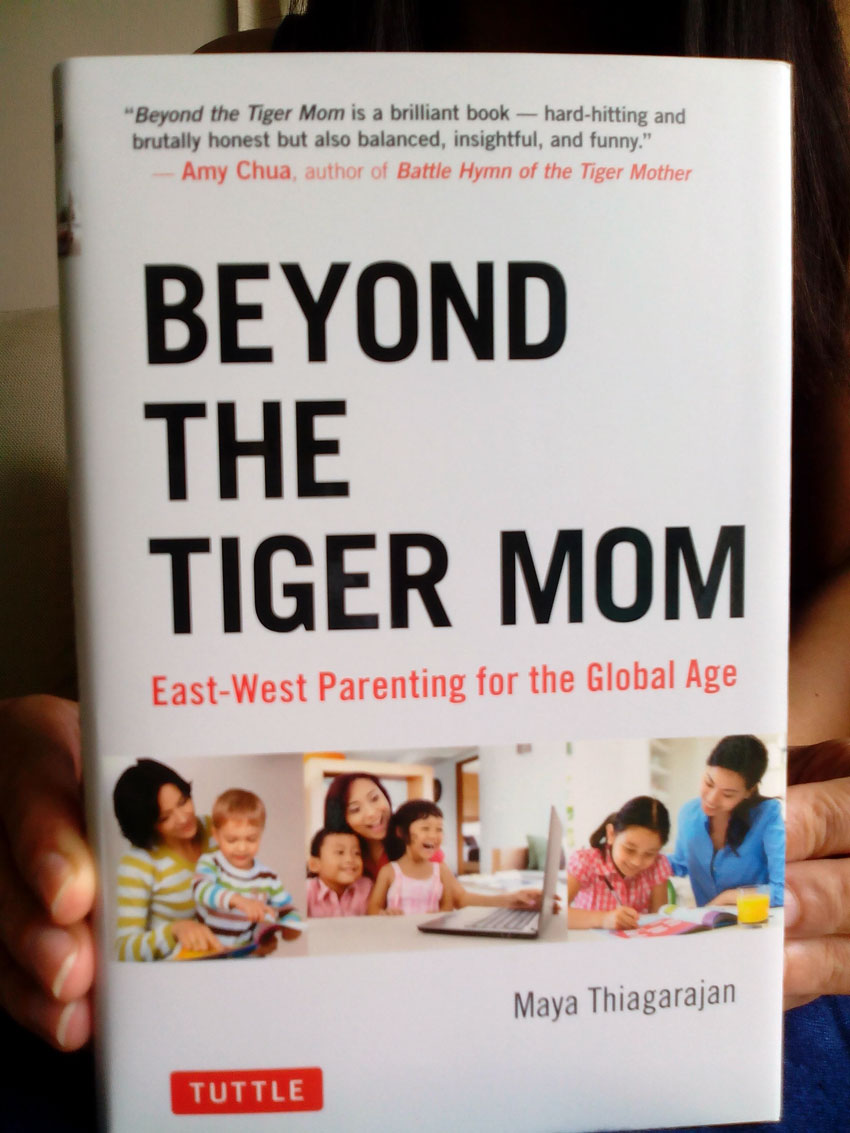
Cover of “Beyond the Tiger Mom.”


Saturday, 12 March 2016

Is it possible to raise creative kids in Singapore?

I recently gave a talk about my book to a largely Singaporean audience at the Raffles Town Club. I was speaking to members of DUAL -- the Distinguished University Alumni League, here in Singapore.

The conversation was interesting, but there seemed to be one over-riding concern that parents had: how could they raise creative kids in a system that seemed designed to squash and kill creativity?

My advice -- which I write about in Beyond The Tiger Mom -- is to counterbalance school at home as much as possible.

How can parents do that? Here are three suggestions:

1. TIME IN NATURE
Get kids outside and then give them time to do what they want. Let nature and childhood work their magic. Let kids play!
Given that 90% of Singaporean teens are myopic and that stress levels, particularly during exam time, run dangerously high, we need to let kids recover and rejuvenate by giving them free time out in nature. It will help their eyes (myopia is linked to too little time outdoors), their physical health, their mental health, and it will free them up to be more creative.
Check out chapter 4 in Beyond the Tiger Mom, and Richard Louv's book "Last Child in the Woods" for more info.

2. ENCOURAGE KIDS TO ASK QUESTIONS
As I've written about in previous posts, exams are all about getting the right answer. But to be more creative, our kids don't need to check a box and give an examiner the right answer, they need to come up with good questions. In an exam-oriented educational system, kids become well-trained to anticipate what an examiner is looking for and then give the right answer. But we need to counterbalance that by encouraging our kids to ask the right questions.
Ask your kids, "What questions do you have about ________?"
Model questions yourself: "I often wonder why __________?"
Talk to your kids about the importance of asking questions.
When kids ask questions, engage them in a discussion. Don't shut them down, but instead, focus on getting them to speak up more and ask more questions. Encourage questioning in every way you can.
For young kids, create a wonder wall in your kids bedroom, and have them post questions and "wonderings" that they come up with.

3. ENCOURAGE THE ARTS
The Singapore Local System has four main tested subjects in elementary/junior school: Math, Science, Mother Tongue, and English Language.
What's missing? The Humanities, Literature and the Arts.
While schools may offer these subjects as fringe subjects in the curriculum, parents and educators routinely tell me that "what gets tested gets taught," so most time and energy at school is diverted towards tested (PSLE) subjects.
And when we don't encourage our kids to immerse themselves in literature, the humanities and the arts, we risk creating a very one-dimensional population. We need to give our kids exposure to history, literature, and art so that they can begin to develop empathy, perspective, and creativity. Through these subjects -- particularly the arts -- we offer our kids the ability to imagine and create, to think in different ways.
As parents, we can supplement a local education by offering kids time and space to read, paint, sing, act, and daydream. Encourage the arts. As this wonderful article illustrates, they may not help with exam scores in the short run, but they will pay off in the long run!


Saturday, 5 March 2016

Does it matter if kids can't identify a verb?

So here's an interesting article from Ed Week about grammar making a (sort-of) comeback in American classrooms because of the increased complexity of Common Core texts.

I've thought about grammar instruction a lot for a number of reasons:

1. I'm a full-fledged grammar geek.  I love thinking about language at the level of the sentence.
Additionally, my own knowledge of grammar has helped me write, edit, and teach better. Therefore, it's important to me that my own kids and my students have a solid understanding of basic grammar and punctuation rules/concepts.

but more importantly,

2. These days, my high school students often arrive in grade 9 not knowing ANYTHING about grammar and punctuation.
(And these kids come in not just from the school where I teach but from schools around the world, mostly American/International schools. They are privileged kids who've attended good schools.)

Many kids have no idea what a verb is. 

One bright and earnest student asked me, "Ms.T, what's that 'sky comma' that people often use at the end of a word before an s?" 
She was talking about an apostrophe -- she had never been taught how to use an apostrophe. And this kid had attended very elite, expensive American schools before arriving in my classroom.

So what's going on? Does basic grammar and punctuation just not matter anymore? Should it be taught? And if so, how and when?

Here are my thoughts on the matter:

1. Explicit grammar instruction has value only IF it is taught systematically with the goal of mastery.

If kids just get a bit of grammar instruction here and there with the goal of mere exposure to concepts, then it's a total waste of time. It won't stick, and it won't have any value at all. Grammar, in this case, is a bit like math. If you're going to teach it, the goal has to be mastery.

2. Teaching grammar in isolation doesn't automatically mean that kids will use these grammar rules in their writing, so teachers have to carefully think about how to encourage that transfer of skills.

Even if a school has a strong, explicit, systematic grammar curriculum, as a few fantastic prep schools do (like The Winsor School in Boston, where I taught for three years early in my career), teachers still have to strategically help kids see the connections between grammar lessons and actual authentic writing.

3. If you're a parent and you care about grammar instruction, your best bet is to teach it yourself because most schools either don't teach grammar at all, or they teach it in such a haphazard way that it's a waste of time.

(Full disclosure: I teach my own kids grammar - we do half an hour lessons every weekend. I'm hoping they learn to love the mechanics of language the way I do.)

4. And of course, grammar instruction ONLY works alongside a reading-rich curriculum/environment, where kids are seeing grammar at work in context.

When kids read a book, they can see what writers are doing with language, and they are exposed to a wide range of different sentence structures and grammatical patterns. Wide and repeated exposure will hone their intuition for language, and they'll absorb an intuitive understanding of grammar and punctuation, even if they can't accurately identify parts of speech or diagram a sentence.
So if you don't feel comfortable teaching your kids grammar, don't worry -- just get them to read extensively, and they'll probably pick up many grammatical concepts just through reading.

Monday, 29 February 2016

Why Singaporeans love Beyond the Tiger Mom!

Here's a lovely review by June Wan of Singapore Motherhood! To see the complete interview and review, check out the full article in Singapore Motherhood.

Review: Beyond The Tiger Mom: East-West Parenting for the Global Age by Maya Thiagarajan

Singaporean parents, in particular, will love this book. Not just because each chapter concludes with pages of tips and how-tos on topics close to our hearts — how to build a math-rich home, how to help your child memorise information, how to supplement your child’s education are some examples —  but also because author Maya is a parent who is particularly like us.
Like us, she straddles an east-west divide when it comes to parenting. Like us, her heritage is Asian. Like us, she had a Western-based education delivered in English. And most of all, like us, when it comes to parenting, she is sometimes confused about which style to follow – the stricter, more structured, authoritarian, academics-driven Asian style, or the freer, more independent, Western-style with its emphases on positive discipline, creativity, and freedom.
Just as there is no perfect style of parenting, there is no perfect answer. The solution, Maya suggests, lies within the straddle. And here, once again, it is typically Singaporean. Her interviews with parents in Singapore reinforce our ‘uniquelySG’ quirks. “I know I’m a kiasu mum because I feel more anxious than my son does when he takes an exam,” one admits.
The Asian obsession with tuition is accepted with wry acceptance: “One mother estimated that thirty out of the thirty-five students in her son’s class… attended tuition in all their major academic subjects. Her son himself spends all day Saturday at tuition classes.”
As one foot remains firmly planted on Asian soil, Maya encourages us to embrace the western tenets of 21st-Century parenting — to help our children develop a growth mindset, to frame failure as a learning experience — to move along with changes in technology that have made parenting now so different from what we know and how we were brought up.
Perhaps, while waiting for the child’s tuition class to end, mum (or dad) could read this book. You’ll chuckle over parental excesses, probably identify with most of them, devour the parenting and teaching tips at the end of each chapter, find community with parents featured, and come away reassured that your style of east-west parenting — whether you’re a Tiger parent or not — is the right way to raise your little Asian Tiger. — June Wan